

Chasing England’s Fading Medieval Wall Paintings
A trip to St Botolph's Church, where medieval paintings rot.
‘If you could tell people one thing about this country’s medieval heritage, what would it be?’
It’s rotting.
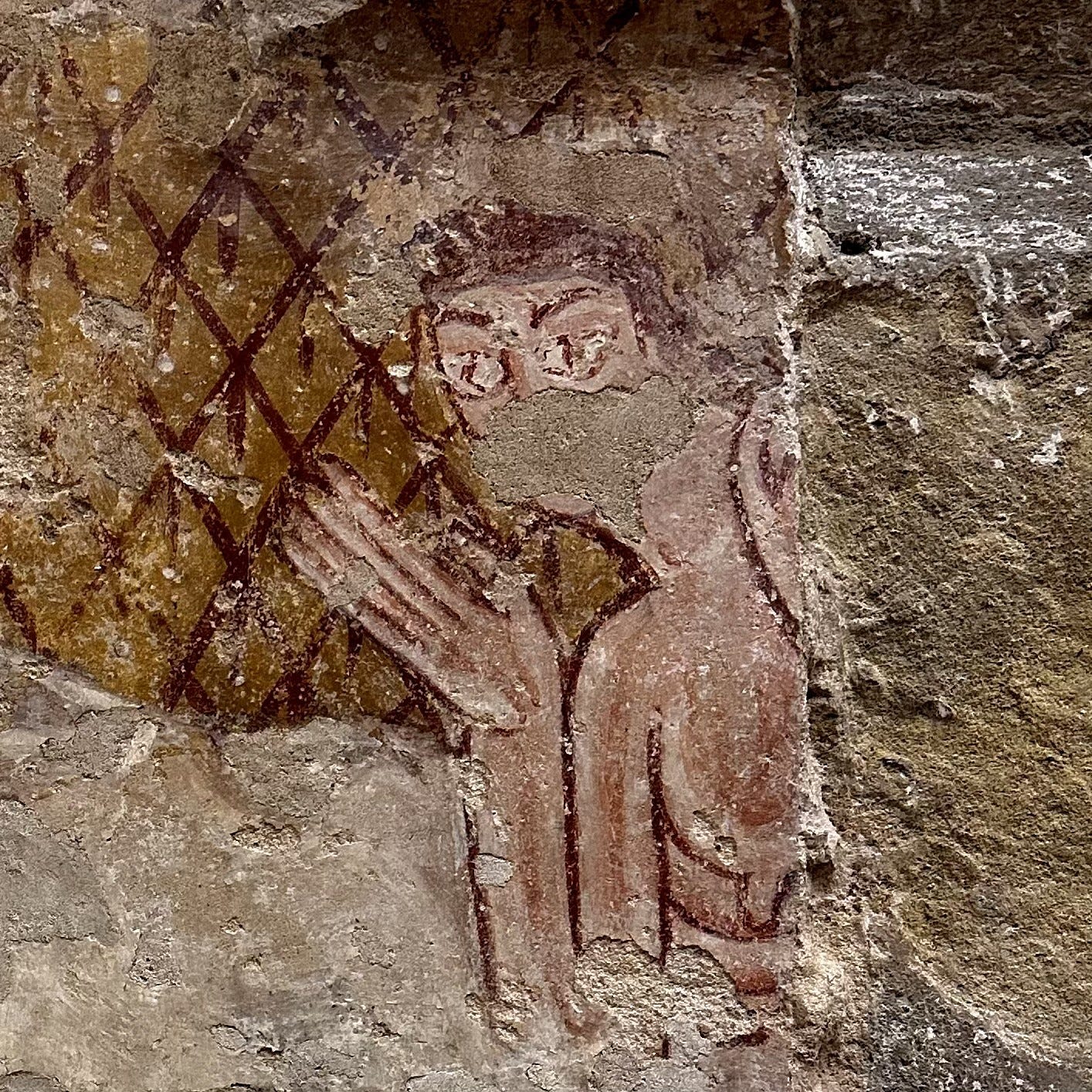
There’s an odd dissonance to life as a medievalist. If I want to view a twelfth-century illuminated manuscript, I must contact the library and supply a letter of recommendation (to tell them I’m not going to steal or eat it), turn up on my assigned day, sit in my assigned seat in a temperature-controlled room, and touch the item as little as possible, if at all. When I visited St Botolph’s Church in Hardham, someone had put a half-empty can of coke on the window ledge above a twelfth-century fresco, and the medieval paint was covered in mould.
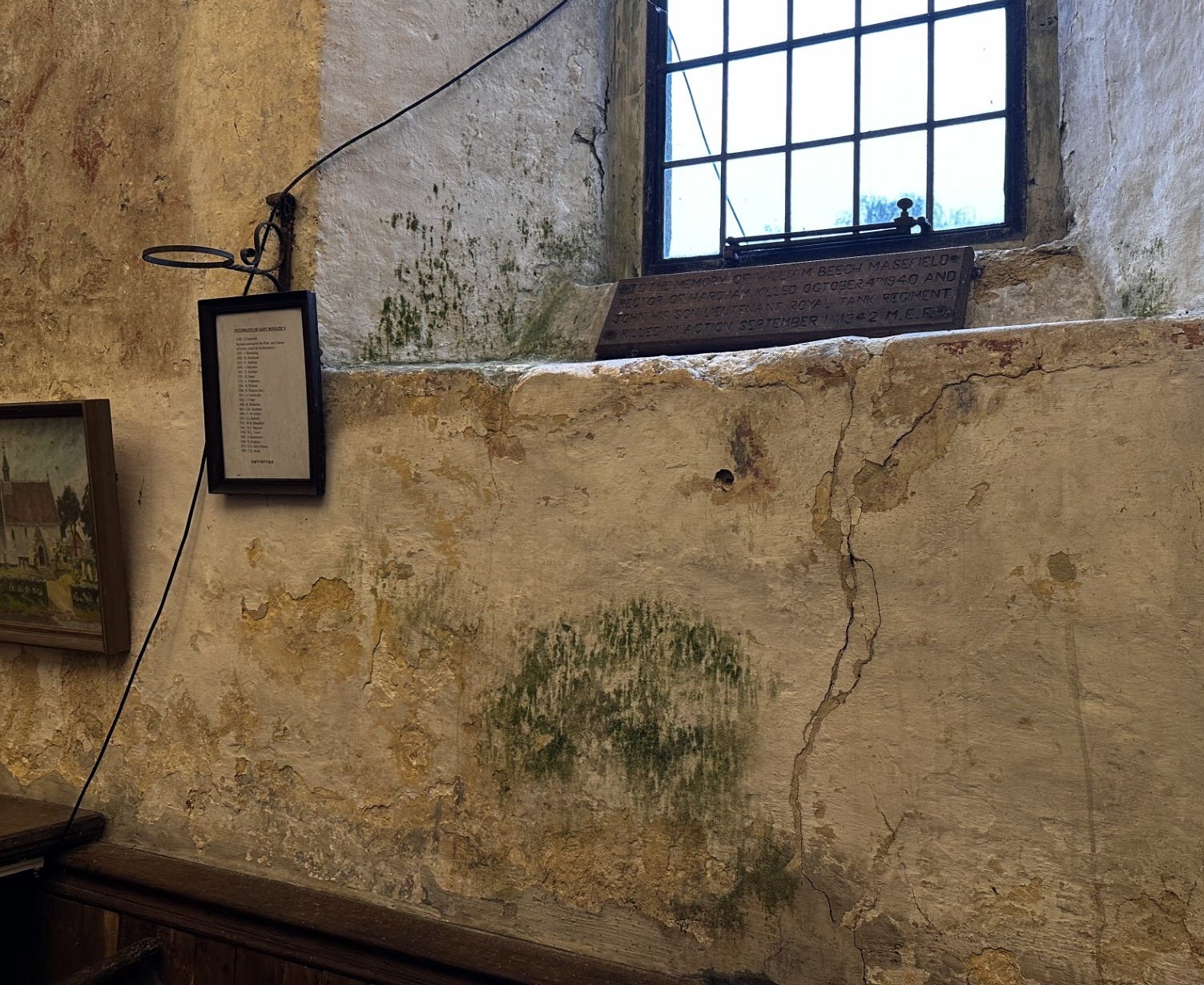
As early as 1687, the diocesan survey described the walls of the church as ‘all green’.
It bears repeating: when we touch manuscripts, we use fabric chains called ‘snake weights’ to make sure the natural oils of our fingers don’t mar the parchment. The careful practice is indiscriminate; I would be just as gentle with the brittle remains of the Beowulf manuscript as I would be with a supple thirteenth-century cartulary. In comparison, the frescoes of St Botolph’s Church — the ‘most complete scheme of English Romanesque wall painting now existing’— have black mould and moss growing on them.1 This is not a new problem. Unfortunately, as with many other wall paintings, the very building that’s protected these paintings for hundreds of years is a factor in their destruction. As early as 1687, the diocesan survey described the walls of St Botolph’s Church as ‘all green’, and green they remain.
As a conservation environment, a medieval church is almost entirely at odds with a gallery or museum. While museums take care to store their works in low-humidity, temperature-controlled spaces, an English country church is by nature damp and cold (and sometimes filled with bats). The only reason most of these paintings have survived until the modern day is that they weren’t always so exposed. For unknown reasons, the scheme at Hardham was covered with limewash just a hundred years after its construction, before being rediscovered in 1866.
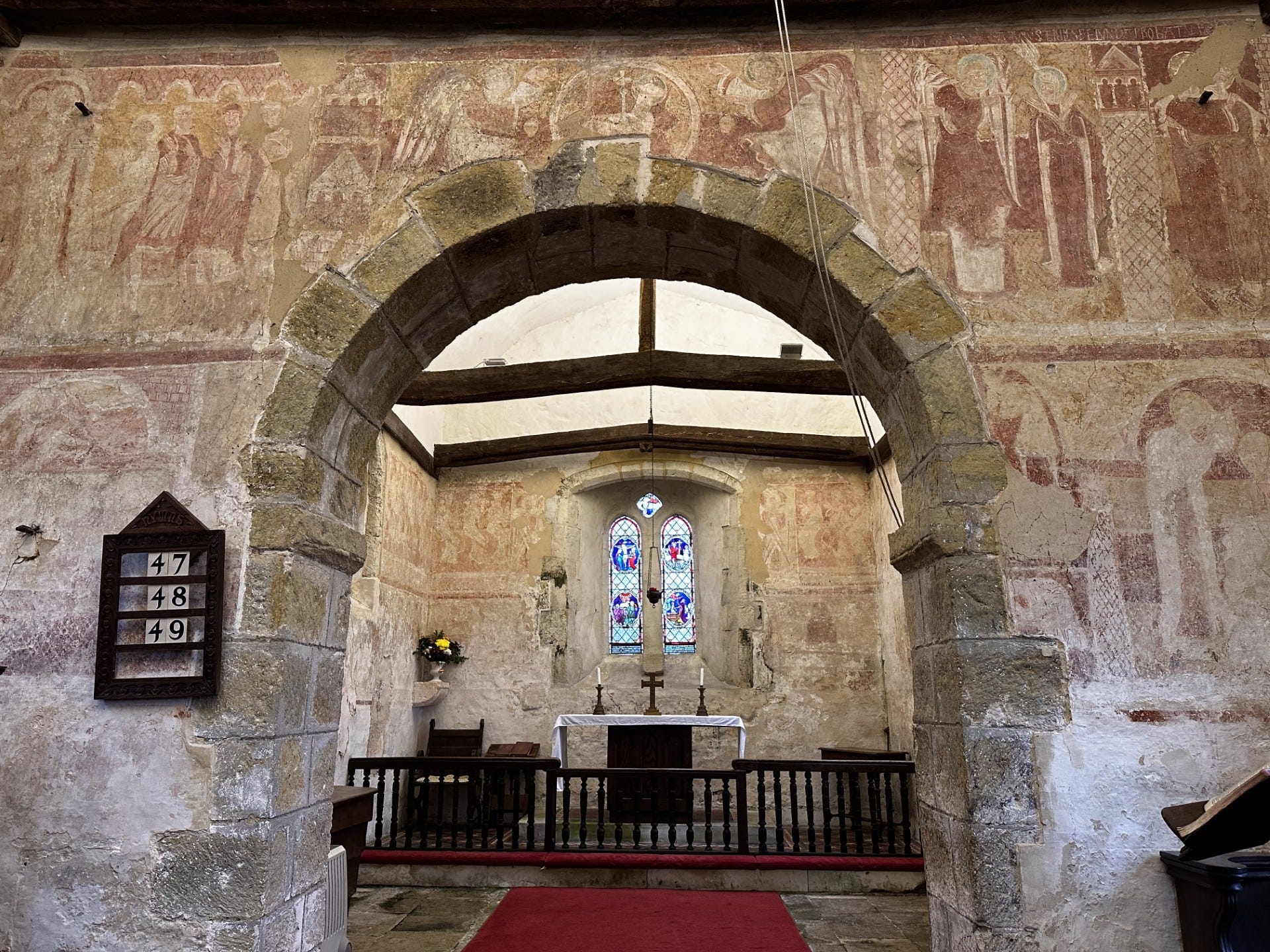
Now, for a brief history lesson. In the medieval period, it was common for churches to commission wall paintings from groups of travelling lay-painters. The so-called ‘Lewes Group’ that painted St Botolph’s Church are possibly the best-known of the period, a prominence that stems from a variety of factors. As David Park states:
The present high importance of the Lewes Group paintings derives from their exceptionally early date, the comparatively large amount of painting which still survives; and the fact that they are a group, rather than just isolated survivals like virtually all other Romanesque wall paintings in England.2
Similarities between the schemes at five different churches (Clayton, Coombes, Hardham, Plumpton and Westmeston) suggest the group worked partly from model-books, partly from memory.3 They used locally-sourced pigments such as red and yellow ochre, giving the surviving paintings a palette often described as ‘bacon-and-egg’ in hue.4 However, the skill of the artists far surpasses the limitations of their materials. They were not using the ‘dry fresco’ technique popularised just a century later, but authentic buon fresco, wet paint applied to wet plaster. As the plaster dried, the paint was set into it, providing a long-lasting image that is chemically bound to its base. Using this time-sensitive technique, the paintings become part of the wall.
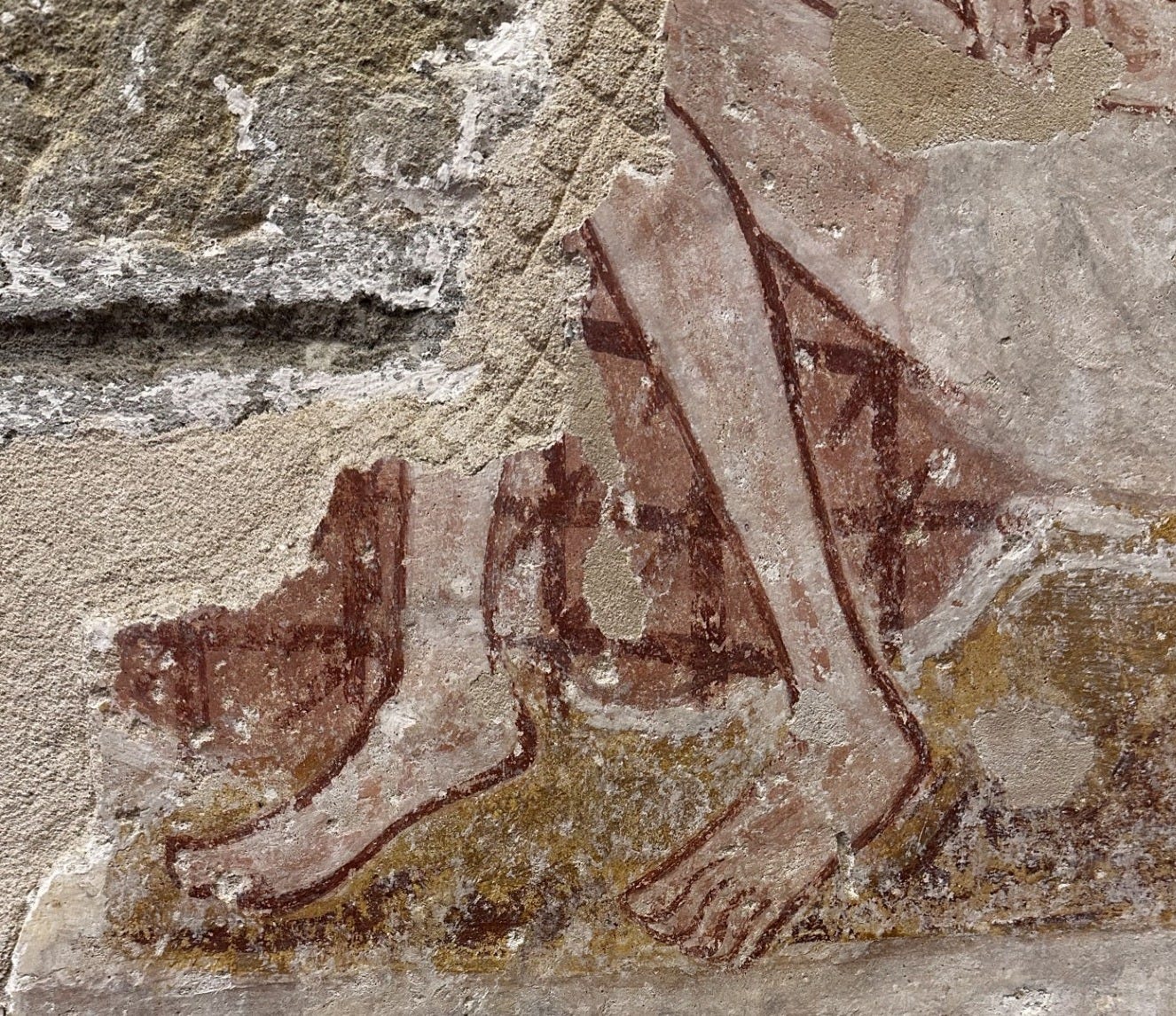
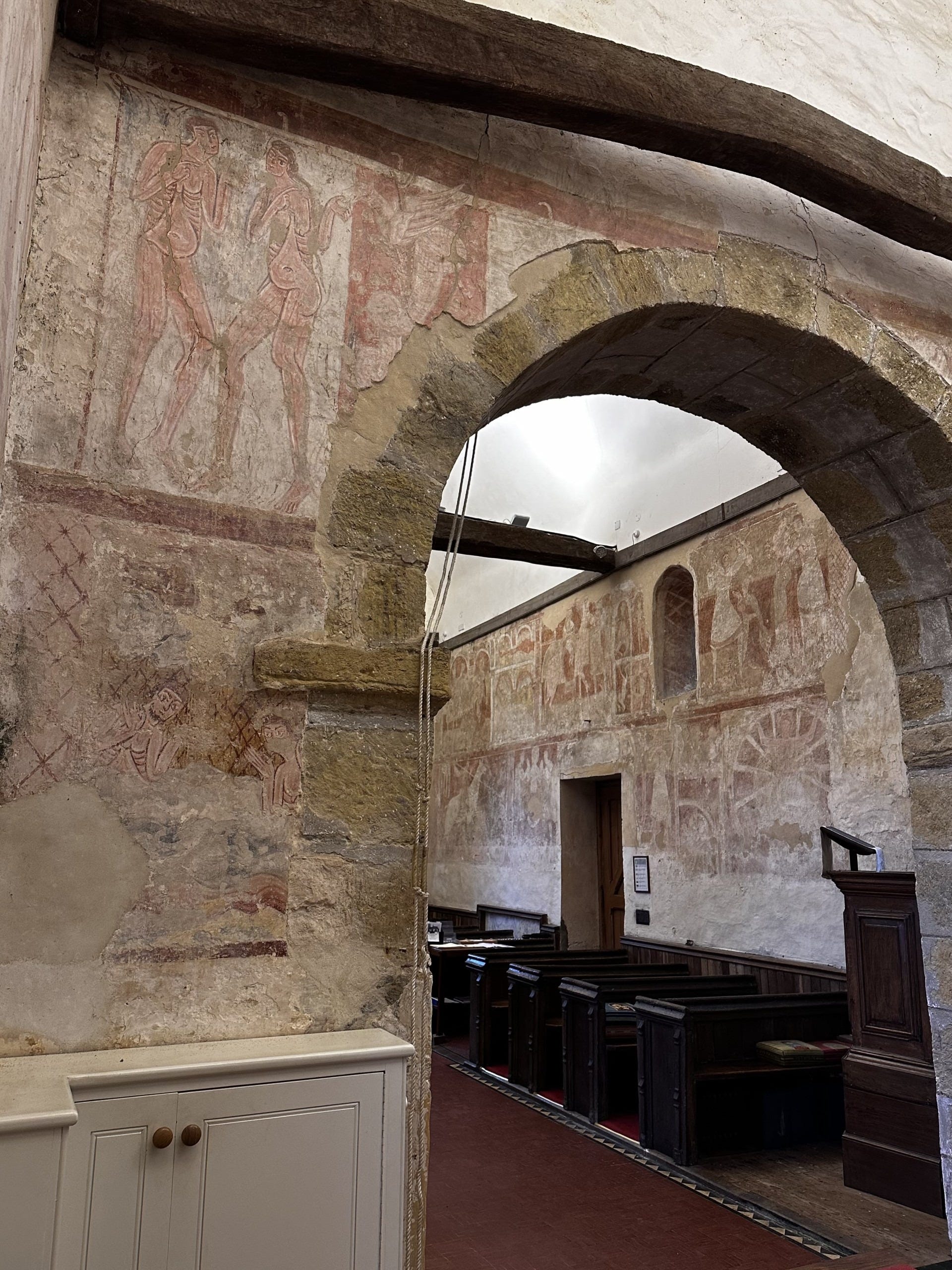
There are several key features of Lewes Group paintings. As David Park states, the artists were not aiming for realism; the figures’ elongated bodies are marked out with heavy brown outlines and their hair is often ‘piled up in beret- or helmet-like masses’.5 The backgrounds are used as a structural device, with towers separating different scenes within the same areas. While certain features seem to be borrowed from Anglo-Saxon traditions (the anatomy of Adam and Eve, rendered androgynous by the ‘pot-belly’ swoosh of their stomachs, recalls the depiction of the same figures in Bodleian Library MS Junius 11), the overall impression is entirely Romanesque.
The curse of these paintings’ exceptional preservation is that there’s almost nothing to compare them to. So few complete schemes of painting survive from the Anglo-Norman period that scholars have often found themselves drawing parallels between the Hardham frescoes and the Bayeux Tapestry.6 This is in no small part due to the fact that the Hardham scheme was literally drawn to resemble a tapestry, a fascinating example of medieval trompe-l’oeil that’s most evident in the white rail painted above the Temptation, complete with painted curtain hooks designed to hold the fake tapestry up. Elsewhere in the scheme, a series of Lombardic capitals can be found, displaying the statement VIRGO SALUTATUR STERILIS FECUNDA PROBATUR (the virgin is greeted. The sterile one is proved fertile). The basic language recalls the tituli of the Bayeux tapestry, which are also often written in the present tense passive indicative, such as HIC DOMUS INCENDITUR (here, a house is burned).
A combination of text and image makes sense in the literate context in which the Bayeux Tapestry was displayed (as Benjamin Pohl suggested just last week, it may have been monastic mealtime reading) but is less explicable in a remote country church. Who was reading these captions? The simplicity of the language could be easily interpreted by anyone with a basic grasp of Latin, but it is likely that the majority of the congregation at Hardham were illiterate, and the Latin literacy of the priest is by no means assured. Unfortunately, this is a question beyond my ability to answer. There’s still much to be learnt about how text and image were interpreted in lay contexts across the medieval period, especially in rural communities.
The extreme degradation of the Hardham frescoes is something of a double-edged sword, as the near-loss of the paintings has rekindled academic interest in the site. St Botolph’s Church was added to Historic England’s Heritage at Risk Register in November 2024, greatly increasing the chances that its paintings will survive. While bureaucracy moves slowly, it is moving in the right direction; in July 2025, representatives from Historic England, the Courtauld Institute of Art and the Church of England visited Hardham to discuss the issues facing the church. Their conversations were productive. As Sally Hales states, ‘efforts are now underway to better understand the condition and environment, with hopes that a major conservation project might be undertaken with research opportunities closely linked’. In the meantime, the church accepts donations through its parish website, found here.
However, the struggle to preserve England’s wall paintings doesn’t stop at Hardham. This is a tale I’ve seen time and time again. The familiar heft of opening an old church door, accompanied by the small of damp plaster. Patches of mould growing on ancient ochre. It is not that these wall paintings are kept in cold damp buildings; it’s that they are the cold damp buildings. When the churches rot, the history rots with it, and the churches don’t have enough money to keep the heating on. In August 2025, the Churches Conservation Trust launched their annual appeal ‘Layers of Time, Protecting our Painted Heritage’, which breaks down the sheer cost of maintaining wall paintings (£1000-3000 per square metre). As a PhD student living on a stipend, the top-billing £10,000 donation — enough to clean and strengthen a wall or ceiling painting — is slightly out of budget. However, I hope this inspires some people to donate. After all, it’s raining in London as I type this, and it will be raining in Hardham as well.
A note: while I am doing a PhD on early medieval manuscripts, I am not an expert on medieval wall paintings. This article was researched with love and passion, but I defer to my sources, who know far more about this subject than me.
David Park, ‘The “Lewes Group” of Wall Paintings in Sussex’ in Anglo-Norman Studies VI: Proceedings of the Battle Conference 1983, ed. by R. Allen Brown (Woodbridge: Boydell Press, 1984), 201-237
Park, ‘Lewes Group’, p. 202.
Park, ‘Lewes Group’, p. 233.
As quoted by Simon Jenkins’ entry for ‘Hardham’ on the Great English Churches website. Available here.
Park, ‘Lewes Group, p. 222.
As in Park, ‘Lewes Group’. Recently discussed on the Historic England blog.
This is the first piece I’ve read of yours but just wanted to say you write with such clarity. You have made this information equitable, to even a layperson like me. But it’s not just easy to read, it’s also so very enjoyable to read—thoughtful and clear. So excited to subscribe and keep up with more of your wonderful writing!
How do you think one could get involved with working hands on on the restoration? Is it silly to think I could just call someone?
Funnily enough I went to a lecture last month about the mediaeval Church paintings in Cornwall. The lecturer pointed to the poor state of some of these and how they have deteriorated even in the last 10 years. The other thing your lovely post reminded me of is J L Carr’s beautiful book “A month in the country” I know PhD students don’t get much time but it’s a beautiful read about the restoration of a mediaeval wall painting and the healing of two souls after war.